The Principles Behind Feng Shui
The Principles Behind
Feng Shui
Below is a clear overview of the foundations that shape how space behaves.
These concepts run far deeper than what follows.
But this page gives the ground on which the entire system rests.
Below is a clear overview of the foundations that shape how space behaves. These concepts run far deeper than what follows.
But this page gives the ground on which the entire system rests.
QI - THE PULSE BENEATH EVERYTHING
What Qi Is
Qi is the movement that keeps life responsive, the quiet current linking body, space,
and environment.
In modern terms, it’s the continuous exchange of air, light, and form that maintains equilibrium between the body’s rhythm and its surroundings.
When that movement stagnates, the system dulls: rooms feel heavy, thought grows cloudy,
sleep skims the surface.
When it flows, attention sharpens and the body experiences vitality.
How Qi Behaves
Air that moves freely carries clarity; stagnant air gathers carbon dioxide, dust, and humidity, the qualities of dull Qi.
Research from Harvard’s Healthy Buildings Program [1] found that small rises in indoor CO₂ (around 1,000 ppm) slowed focus and decision-making.
Light follows the same rhythm:
as it softens from noon’s glare to evening warmth, the body unclenches, thought slows, and calm focus takes over, a pattern confirmed by LBN Lab [2] studies on dynamic lighting.
In form, Qi flows through continuity:
open paths and clear sightlines let it “breathe”, while blockages or sharp turns scatter its movement.
How to Use it
For Yourself
Your body already tells you when a space isn’t working. You feel restless, tense, or distracted for no clear reason.
Notice where you hesitate, rush, or avoid sitting. These reactions signal friction between your body and the layout.
Observe when you feel motivated and alert in a space, and when you feel bored, dull, or resistant. Your state of mind reflects the state of the space around you.
Identify the spot where you feel most at ease.
That contrast shows what the space is missing elsewhere.
Result:
You stop guessing and start recognising where the problem actually lives.
For your Property
Most homes don’t fail because of style.
They fail because movement, light, and function conflict.
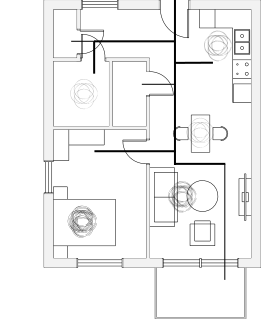
Trace your daily paths through the space.
Where you detour, squeeze, or step around furniture, flow is blocked.
Clarify one uninterrupted route through the room.
This reduces mental noise and restores a sense of order.
Reduce sharp contrasts between bright and dark zones.
Balanced transitions calm the nervous system and improve focus.
Start with the entrance.
Clearing visual and physical obstruction there often releases tension across the entire home.
Result:
The space becomes easier to use, easier to think in, and easier to rest in.
Summary
What Chinese thought describes as Qi:
the force moving through all phenomena,
Western science divided into fields: airflow, light, magnetism, metabolism.
Different words for the same movement.
Life responding to its environment.
Study References
[1] Harvard Healthy Buildings Program
https://ehp.niehs.nih.gov/doi/10.1289/ehp.1510037
[2] Lawrence Berkeley National Laboratory
https://pmc.ncbi.nlm.nih.gov/articles/PMC9602902
YIN AND YANG - THE RHYTHM
BETWEEN ACTIVITY AND REST
What It Is
Yin and Yang describe the pulse of contrast that sustains life.
Activity and recovery, light and shadow, sound and silence.
Neither exists alone; one gives the other meaning.
In nature, this rhythm unfolds as chaos and order, day and night, summer and winter.
In human life, the same alternation governs alertness and sleep, stimulation and restoration.
Spaces that ignore this cycle:
too bright, too noisy, or too dim for too long, strain the body’s internal clock.
How It Behaves
Light is the main conductor of this rhythm.
Morning brightness signals the body to release cortisol and activate,
the fall of light forces the pineal gland to release melatonin telling the body “it’s time to wind down”.
Studies in the Journal of Biological Rhythms [1] show that late exposure to cold light suppresses melatonin and delays deep sleep, while natural daylight early in the day improves focus and mood stability.
Temperature and sound follow the same polarity: warmth and motion stimulate, coolness and quiet restore.
When workspaces stay lit and active long after dark, or bedrooms glow with screens,
Yin retreats and the nervous system forgets how to downshift.
Balanced environments alternate cues: brighter by day, dimmer and softer by night,
allowing body’s physiology and Qi to breathe in rhythm.
How to Use it
For Yourself
Notice when you feel driven and engaged,
and when you feel flat or resistant.
These shifts are not random;
they reflect how your day is structured.
Begin the day in spaces that support action and momentum.
Movement, freshness, and clarity help you engage without effort.
As the day closes, reduce stimulation
and pace.
Quieter environments allow your system to settle and recover.
Result:
Energy stops spiking and crashing.
You move through the day with rhythm
instead of force.
For your Property
Homes work best when different areas support different states.
Problems arise when everything asks for attention at once. Keep active areas open, bright, and easy to move through.
This supports focus, interaction, and momentum.
Protect resting areas from excess noise, light, and visual clutter. These spaces are meant to slow you down, not compete for attention.
Restore calm daily by clearing stimulation from rest zones and simplicity returns in the home.
Result:
The space supports both productivity and recovery, instead of draining you across the day.
Active (Yang)
Activation
Movement
Focus
Interaction
Entrance
Kitchen
Living
Office
The day naturally moves from activation to recovery
Rest (Yin)
Calm
Stillness
Recovery
Low stimulation
Bedroom
Bathroom
Reading
Storage
Summary
Yin and Yang aren’t opposites to choose between but forces to weave.
In the body, they appear as activation and recovery.
In design, as brightness and dimness.
Modern chronobiology calls it circadian rhythm, the same alternation that Chinese philosophy mapped long before measurement existed.
When light, sound, and temperature follow a rhythm, vitality becomes available and Qi moves without resistance.
Study References
[1] Effects of Light on Human Circadian Rhythms, Sleep and Mood
https://link.springer.com/article/10.1007/s11818-019-00215-x?
FIVE PHASES - THE PATTERN OF CHANGE
What It Is
If Qi is the pulse and Yin–Yang, its rhythm;
the Five Phases describe how that rhythm transforms over time.
It is the sequence through which environments, seasons, and moods shift from one state to another.
In classical thought, they are presented as Wood, Fire, Earth, Metal, and Water.
These are not substances, but processes:
Growth, Expression, Stabilization, Refinement, and Stillness.
Each phase is a configuration of Yin and Yang, the way 0 and 1 combine to generate motion in a digital system.
In modern language, they represent feedback cycles, energy converting along the spectrum of activation and recovery, expansion and contraction.
How They Behave
You can see the Five Phases everywhere:
In the day’s passage from dawn to night,
in the body’s rhythm of focus, exertion, digestion, rest, and sleep.
In space, through transitions of openness, brightness, solidity, reflection, and stillness.
Wood rises, triggering movement and growth.
Fire expands, driving interaction and visibility.
Earth settles, giving structure and support.
Metal contracts, refining form and precision.
Water descends, restoring depth and renewal.
Healthy spaces cycle through these states just as healthy bodies do.
A static space, like a static life, dulls perception.
One that moves through gentle change keeps the nervous system alert yet calm.
How to Use it
For Yourself
The Five Phases describe how your energy rises, peaks, stabilises, releases, and restores through the day.
Notice when you feel growth and direction (Wood),
intensity and expression (Fire), grounding and digestion (Earth), clarity and order (Metal), or quiet recovery (Water).
Adjust your pace to the Phase you are in rather than forcing a different one; this creates a natural rhythm instead of burnout or stagnation.
For your Property
Each Phase governs a different spatial behaviour:
Wood shapes movement, Fire shapes activity, Earth stabilises, Metal refines, Water softens and quiets.
Support these qualities with simple cues;
open routes for Wood, bright active zones for Fire, calm anchored areas for Earth, clean lines for Metal, and soft depths for Water.
Let rooms shift Phase across the day; this keeps Qi cycling rather than locking the home into one constant tone.
State intensity across daylight hours
Wood
Initiation
Movement
Fire
Peak
Action
Earth
Integration
Grounding
Metal
Refinement
Water
Rest
Recovery
Sunset
Sunrise
Summary
The Five Phases “turn” the still picture of Yin and Yang into a moving film;
Qi evolving through time.
They describe not balance but transformation, showing how environments renew their energy by cycling through change.
They reveal how every form, once complete, begins to change, how stillness gives way to movement, and balance renews itself through motion.
DIRECTIONS -
THE INVISIBLE COMPASS OF SPACE
What It Is
Direction gives Qi orientation.
It is the medium through which energy moves between Earth and sky.
Every structure sits inside a larger field: magnetic, atmospheric, and gravitational.
In classical Feng Shui, the compass was not symbolic; it mapped how these invisible lines intersected with human life.
Studies reveal that Earth’s magnetic field creates rhythmic patterns that influence human and animal physiology.
How They Behave
In 2019, researchers at the California Institute of Technology and UCLA [1] discovered measurable brain responses to shifts in Earth’s magnetic field.
Electroencephalography (fancy name for measuring brain’s electrical activity) showed that when the magnetic field rotated, participants’ alpha waves (linked to orientation and calm focus), changed accordingly.
It suggests that humans, like migratory species, may unconsciously sense magnetic direction as part of spatial awareness.
Buildings too have orientation signatures.
Layouts determine how light, wind, temperature, and environmental charge accumulate or disperse.
Spaces that follow their environment are supportive; those that resist it, draining.
How to Use it
For Yourself
Directions shape how Qi meets the body; some directions deliver rising, activating Qi, while others bring settling, withdrawing, or stabilising Qi.
When you face a direction, you receive the quality of that Qi through posture, breath, and mental tone; this is why some orientations make you alert while others make you calm or unfocused.
Using the right direction means aligning your body with the Qi-quality you need: focus, restoration, clarity, or steadiness.
For your Property
Directions determine how different types of Qi enter, gather, or disperse within a structure; they control the building’s natural strengths and weaknesses.
Some directions bring in active Qi that supports movement and activity, while others draw in quiet Qi that supports rest, storage, or stability.
When a property is oriented improperly toward the wrong direction for its function, Qi either overwhelms the space or cannot accumulate; correct orientation lets the house “receive” the right Qi for its purpose.
Summary
Direction does not create energy; it regulates how environmental qualities are received.
By setting a baseline state before effort or intention, orientation reduces or increases background friction.
When direction aligns with use, both the body and the home adjust less and function more smoothly.
In this way, direction acts as the compass of Qi, linking inner navigation to the larger field.
Study References
[1] Transduction of the Geomagnetic Field as Evidenced from Human Brain Responses.
+
How do I apply Feng Shui in an imperfect layout?
+
How do I apply Feng Shui in an imperfect layout?
+
What are the basic principles of Feng Shui?
+
What are the basic principles of Feng Shui?
+
How do I know if my home has “bad” energy?
+
How do I know if my home has “bad” energy?
+
Which direction should my bed or desk face?
+
Which direction should my bed or desk face?
+
Do I need to understand all the principles to benefit from Feng Shui?
+
Do I need to understand all the principles to benefit from Feng Shui?
Frequent Questions
QI - THE PULSE BENEATH EVERYTHING
What Qi Is
Qi is the movement that keeps life responsive, the quiet current linking body, space, and environment.
In modern terms, it’s the continuous exchange of air, light, and form that maintains equilibrium between the body’s rhythm and its surroundings.
When that movement stagnates, the system dulls: rooms feel heavy, thought grows cloudy, sleep skims the surface.
When it flows, attention sharpens and the body experiences vitality.
How Qi Behaves
Air that moves freely carries clarity; stagnant air gathers carbon dioxide, dust, and humidity, the qualities of dull Qi.
Research from Harvard’s Healthy Buildings Program [1] found that small rises in indoor CO₂ (around 1,000 ppm) slowed focus and decision-making.
Light follows the same rhythm:
as it softens from noon’s glare to evening warmth, the body unclenches, thought slows, and calm focus takes over, a pattern confirmed by LBN Lab [2] studies on dynamic lighting.
In form, Qi flows through continuity:
open paths and clear sightlines let it “breathe”, while blockages or sharp turns scatter its movement.
How to Use it
For Yourself
Your body already tells you when a space isn’t working.
You feel restless, tense, or distracted for no clear reason.
Notice where you hesitate, rush, or avoid sitting.
These reactions signal friction between your body and the layout.
Observe when you feel motivated and alert in a space, and when you feel bored, dull, or resistant.
Your state of mind reflects the state of the space around you.
Identify the spot where you feel most at ease.
That contrast shows what the space is missing elsewhere.
Result:
You stop guessing and start recognising where the problem actually lives.
For your Property
Most homes don’t fail because of style.
They fail because movement, light, and function conflict.
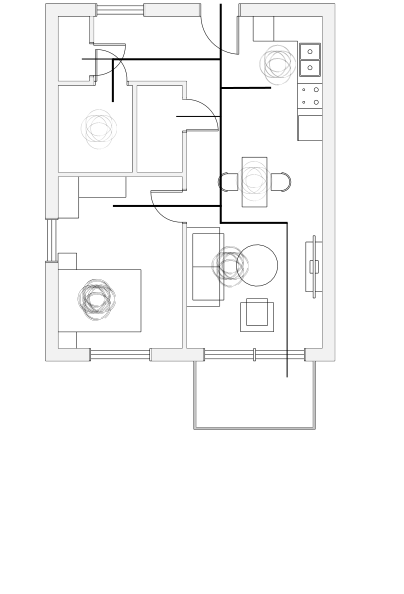
Trace your daily paths through the space.
Where you detour, squeeze, or step around furniture, flow is blocked. Clarify one uninterrupted route through the room. This reduces mental noise and restores a sense of order.
Reduce sharp contrasts between bright and dark zones.
Balanced transitions calm the nervous system and improve focus.
Start with the entrance.
Clearing visual and physical obstruction there often releases tension across the entire home.
Result:
The space becomes easier to use, easier to think in, and easier to rest in.
Summary
What Chinese thought describes as Qi: the force moving through all phenomena,
Western science divided into fields: airflow, light, magnetism, metabolism.
Different words for the same movement.
Life responding to its environment.
Study References
[1] Harvard Healthy Buildings Program
https://ehp.niehs.nih.gov/doi/10.1289/ehp.1510037
[2] Lawrence Berkeley National Laboratory
https://pmc.ncbi.nlm.nih.gov/articles/PMC9602902
YIN AND YANG -THE RHYTHM BETWEEN ACTIVITY AND REST
What it Is
Yin and Yang describe the pulse of contrast that sustains life.
Activity and recovery, light and shadow, sound and silence.
Neither exists alone; one gives the other meaning.
In nature, this rhythm unfolds as chaos and order, day and night, summer and winter.
In human life, the same alternation governs alertness and sleep, stimulation and restoration.
Spaces that ignore this cycle: too bright, too noisy, or too dim for too long, strain the body’s internal clock.
How it Behaves
Light is the main conductor of this rhythm.
Morning brightness signals the body to release cortisol and activate, the fall of light forces the Pineal gland to release melatonin telling the body “it’s time to wind down”.
Studies in the Journal of Biological Rhythms [1] show that late exposure to cold light suppresses melatonin and delays deep sleep, while natural daylight early in the day improves focus and mood stability.
Temperature and sound follow the same polarity: warmth and motion stimulate, coolness and quiet restore.
When workspaces stay lit and active long after dark, or bedrooms glow with screens, Yin retreats and the nervous system forgets how to downshift.
Balanced environments alternate cues: brighter by day, dimmer and softer by night, allowing body’s physiology and Qi to breathe in rhythm.
How to Use it
For Yourself
Notice when you feel driven and engaged, and when you feel flat or resistant.
These shifts are not random; they reflect how your day is structured.
Begin the day in spaces that support action and momentum.
Movement, freshness, and clarity help you engage without effort.
As the day closes, reduce stimulation and pace.
Quieter environments allow your system to settle and recover.
Result: Energy stops spiking and crashing.
You move through the day with rhythm instead of force.
For your Property
Homes work best when different areas support different states.
Problems arise when everything asks for attention at once.
Keep active areas open, bright, and easy to move through.
This supports focus, interaction, and momentum.
Protect resting areas from excess noise, light, and visual clutter.
These spaces are meant to slow you down, not compete for attention.
Restore calm daily by clearing stimulation from rest zones
and simplicity returns to the whole home.
Result:
The space supports both productivity and recovery,
instead of draining you across the day.
Active (Yang)
Activation
Movement
Focus
Interaction
Entrance
Kitchen
Living
Office
The day naturally moves from activation to recovery
Rest (Yin)
Calm
Stillness
Recovery
Low stimulation
Bedroom
Bathroom
Reading
Storage
Summary
Yin and Yang aren’t opposites to choose between but forces to weave.
In the body, they appear as activation and recovery.
In design, as brightness and dimness.
Modern chronobiology calls it circadian rhythm, the same alternation that Chinese philosophy mapped long before measurement existed.
When light, sound, and temperature follow a rhythm, vitality becomes available and Qi moves without resistance.
Study References
[1] Effects of Light on Human Circadian Rhythms, Sleep and Mood
https://link.springer.com/article/10.1007/s11818-019-00215-x?
FIVE PHASES - THE PATTERN OF CHANGE
What it Is
If Qi is the pulse and Yin–Yang, its rhythm; the Five Phases describe how that rhythm transforms over time.
It is the sequence through which environments, seasons, and moods shift from one state to another.
In classical thought, they are presented as Wood, Fire, Earth, Metal, and Water.
These are not substances, but processes:
Growth, Expression, Stabilization, Refinement, and Stillness.
Each phase is a configuration of Yin and Yang, the way 0 and 1 combine to generate motion in a digital system.
In modern language, they represent feedback cycles, energy converting along the spectrum of activation and recovery, expansion and contraction.
How They Behave
You can see the Five Phases everywhere:
In the day’s passage from dawn to night, in the body’s rhythm of focus, exertion, digestion, rest, and sleep.
In space, through transitions of openness, brightness, solidity, reflection, and stillness.
Wood rises, triggering movement and growth.
Fire expands, driving interaction and visibility.
Earth settles, giving structure and support.
Metal contracts, refining form and precision.
Water descends, restoring depth and renewal.
Healthy spaces cycle through these states just as healthy bodies do.
A static space, like a static life, dulls perception.
One that moves through gentle change keeps the nervous system alert yet calm.
How to Use it
For Yourself
Your energy shifts through the day whether you plan it or not.
Some moments pull you forward. Others slow you down.
Some demand focus. Others ask for rest.
Problems begin when these states are ignored or overridden.
Pushing through fatigue creates burnout.
Forcing calm during momentum creates frustration.
What feels like inconsistency is usually misalignment.
You’re not lacking discipline, you’re operating out of phase.
When your pace matches the state you’re already in,
effort spreads evenly.
Result: Resistance reduces and the day gains direction.
For your Property
Homes don’t just hold objects.
They lock you into patterns.
When every room demands the same tone,
constant stimulation or constant calm,
the system drains instead of cycling.
Spaces need contrast to function well.
Movement zones need openness.
Active zones need clarity and light.
Resting zones need depth and quiet.
When rooms are allowed to support different states,
the home stops fighting your rhythm and starts reinforcing it.
Result: The space supports change instead of resisting it.
State intensity across daylight hours
Wood
Initiation · Movement
Fire
Peak · Action
Earth
Integration · Grounding
Metal
Refinement
Water
Rest · Recovery
Sunset
Sunrise
Summary
The Five Phases “turn” the still picture of Yin and Yang into a moving film; Qi evolving through time.
They describe not balance but transformation, showing how environments renew their energy by cycling through change.
They reveal how every form, once complete, begins to change, how stillness gives way to movement, and balance renews itself through motion.
DIRECTIONS - THE INVISIBLE COMPASS OF SPACE
What it Is
Direction gives Qi orientation.
It is the medium through which energy moves between Earth and the Universe.
Every structure sits inside a larger field: magnetic, atmospheric, and gravitational.
In classical Feng Shui, the compass was not symbolic; it mapped how these invisible lines intersected with human life.
Studies reveal that Earth’s magnetic field creates rhythmic patterns that influence human and animal physiology.
How They Behaves
In 2019, researchers at the California Institute of Technology and UCLA [1] discovered measurable brain responses to shifts in Earth’s magnetic field.
Electroencephalography (fancy name for measuring brain’s electrical activity) showed that when the magnetic field rotated, participants’ alpha waves (linked to orientation and calm focus), changed accordingly.
It suggests that humans, like migratory species, may unconsciously sense magnetic direction as part of spatial awareness.
Buildings too have orientation signatures. Layouts determine how light, wind, temperature, and environmental charge accumulate or disperse.
Spaces that follow their environment are supportive and those that resist it, draining.
How to Use it
For Yourself
Direction does not create energy.
It regulates how your body meets what is already present.
When you face a direction, your nervous system interfaces first with a specific environmental field: light angle, airflow, temperature, and subtle orientation cues.
This happens before thought.
That is why some orientations sharpen attention, while others soften it or draw it inward.
The effect is not emotional and not intentional.
It is a baseline readiness: alert, steady, or withdrawn, set before effort begins.
When your orientation matches the state required by the moment, internal adjustment drops and focus holds without force.
Result: Minimal resistance. Clear direction.
For your Property
Buildings do not receive Qi evenly.
Orientation determines which environmental qualities enter first and dominate.
Some directions favour movement, visibility, and activity.
Others favour containment, stillness, and recovery.
Problems arise when orientation and function conflict.
Active areas become overstimulating.
Resting areas never fully settle.
When a space is oriented in line with its purpose, and with the people using it, Qi no longer overwhelms or dissipates.
Result: Rooms behave as intended, and the home supports activity and rest without friction.
Summary
Direction does not create energy; it regulates how environmental qualities are received.
By setting a baseline state before effort or intention, orientation reduces or increases background friction.
When direction aligns with use, both the body and the home adjust less and function more smoothly.
In this way, direction acts as the compass of Qi, linking inner navigation to the larger field.
Study References
[1] Transduction of the Geomagnetic Field as Evidenced from Human Brain Responses.
Frequent Questions
+
What are the basic principles of Feng Shui?
+
How do I know if my home has “bad” energy?
+
Which direction should my bed or desk face?
+
How do I apply Feng Shui in an imperfect layout?
+
Do I need to understand all the principles to benefit from Feng Shui?
Based in London l Working Globally
© Flowtoform. All rights reserved.
Based in London l Working Globally
© Flowtoform. All rights reserved.
Based in London l Working Globally
© Flowtoform. All rights reserved.